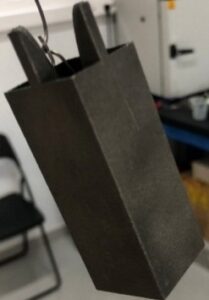
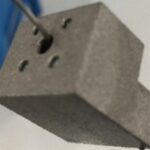
Metallization of plastics is a standard process which involves the immersion of the substrate in highly toxic and/or carcinogenic solutions to etch the surface of the plastic and allow the adsorption of metal cations which will result in electroless deposition. Within FreeMe project, CNano managed to successfully etch several plastic substrates using piranha solution and achieve comparable adhesion values with the state-of-the-art etching method. In the case of PA12 substrate, literature is quite limited and piranha etching solutions fail to provide repetitive etching of complex objects with cavities. CNano developed a method which involves the immersion in an aqueous solution of an organosilane reagent which can form mono- or multilayers onto the plastic surface, thus causing its chemical modification. This modification allows the subsequent metal cation adsorption leading to electroless plating. More specifically, the organosilane reagent contains three alkyl groups binded to a central silicon atom along with an amine moiety. In aqueous solutions, the alkyl groups are hydrolyzed and 3 silanol groups are produced. Two of them are reacting with the silanol groups of another hydrolyzed APTES molecule through condensation reactions, therefore creating a monolayer, whereas the third silanol group is interacting with the surface functional groups of the plastic. The amine group is responsible for the immobilization of the metal cations onto the surface. In CNanoa’s case, subsequent reduction of the metal cations and immersion in an electroless Ni-P solution leads to a uniform metallic coating, even in complex demonstrators, as depicted in the pictures below.
Images of Ni-P metallized PA12 demonstrators (IAI) after surface modification with APTES