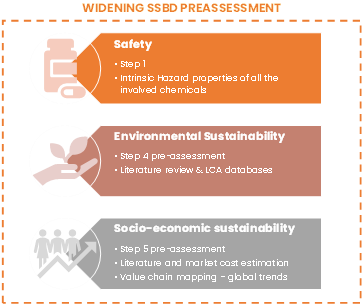
The Safe-and-Sustainable-by-Design (SSbD) framework is a mighty tool to identify the most critical aspects of novel technologies, such as those developed under the ‘FreeMe’ project. This strategy is being applied in parallel to the technical research carried out within ‘FreeMe’. The SSbD framework consists of five steps, the first of which, Step 1, is a preliminary assessment of the chemicals involved from the toxicological point of view. This hazard evaluation allows to determine if such reagents are safe or not; for the harmful substances, alternatives are proposed. A first approximation to the final steps of SSbD is also advisable, as it permits to identify key aspects from the environmental (Step 4) and socio-economic (Step 5) angles. In Step 4, a quantification of the impacts associated to the manufacturing of the substances explored in Step 1 is performed, via literature searching and the information gathered in the most common databases, such as Ecoinvent. Economically, the cost of the raw materials is estimated from the literature and the market trends; this includes a monetary appraisal of the environmental impacts into the final cost. Socially, the materials are mapped to ascertain the main producers worldwide, together with the value chains and global trends linked to their manufacture and commercialisation. This way, a pre-assessment of Steps 4 and 5 aids environmental, economic and social decision-making during the first stages of technology development, and is thus applicable to low-TRL technologies. All of this is summarised in Figure 1.
Figure 1. Broadening SSbd pre-assessment to Steps 4 and 5 of the Framework.
In the context of the ‘FreeMe’ project, the application of the described pre-assessment has thrown very interesting results. The work performed under Step 1 indicates that the explored options to substitute Cr(VI) also have high-risk concerns, although in less categories than the conventional method. In the case of Pd, the proposed alternatives pose high risks, so the research was turned to metals safer than those considered at the beginning of the project. The Step 4 pre-evaluation confirms that the environmental impacts due to the traditional products that ‘FreeMe’ intends to replace are much higher than those caused by the proposed alternatives. Therefore, ‘FreeMe’ will definitely contribute to improve the sustainability of the Plating-on-Plastics industry. From the economic (Step 5) perspective, the market trends of the materials that should replace the conventional ones point to a growth, so the new ‘FreeMe’ processes will benefit from enhanced economies of scale. Finally, according to the social (Step 5) pre-assessment, the new reagents show a better performance; however, a deeper research is required, as the country of origin is crucial to make a complete evaluation of the supply chain; this will allow to select the suppliers that generate less risks.
Altogether, the SSbD framework has proved to be a powerful instrument to identify the intrinsic hazards of the studied materials, and to assess the trends of the future technology and the pros and cons that it presents with respect to the traditional approach. The sustainability pre-evaluation will enable exploration of prospective environmental impacts, as well as socio-economic aspects that might influence the future development of the technology. In the end, this will ease early-stage decision-making.
This achievement corresponds to a poster contribution that was presented by Natalia Fernández- Pampín, post-doctoral researcher at ICCRAM-UBU, at the SETAC Europe 34th Annual Meeting. SSbD application: widening Step 1 to environmental, economic and social considerations for early-stage decision-making. Sonia Martel-Martín, Natalia Fernández-Pampín, Julieta Díez-Hernández, Jesús Ibáñez, Mario Santiago-Herrera, Ana García-Moral, Israel Carreira-Barral, Rocío Barros, and Carlos Rumbo.