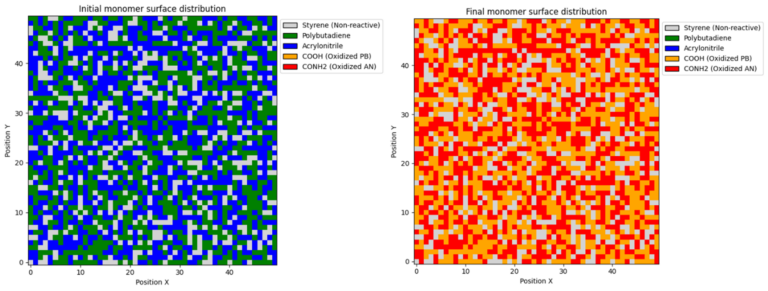
As part of IDENER’s multiscale modeling strategy in the FREEME project, they have implemented a kinetic Monte Carlo (kMC) simulation method to study the oxidation of ABS surfaces when exposed to piranha solution. This approach complements previous Density Functional Theory (DFT) and molecular dynamics work, offering a probabilistic view of how chemical reactions drive surface transformation over time. The simulation mimics the random progression of oxidation reactions across the surface of ABS, considering how likely each reaction is to occur depending on its energetic profile. These probabilities are derived from activation energies previously obtained through DFT calculations. The surface is represented as a collection of monomers, each capable of undergoing specific oxidation reactions. As the simulation progresses, reactions are triggered based on their probabilities, and the state of each monomer is updated accordingly. This dynamic process allows IDENER to observe how the piranha solution gradually alters the ABS surface and increases its surface energy through functional group changes. Currently, additional DFT calculations are underway to refine the simulations and the activation energy values.